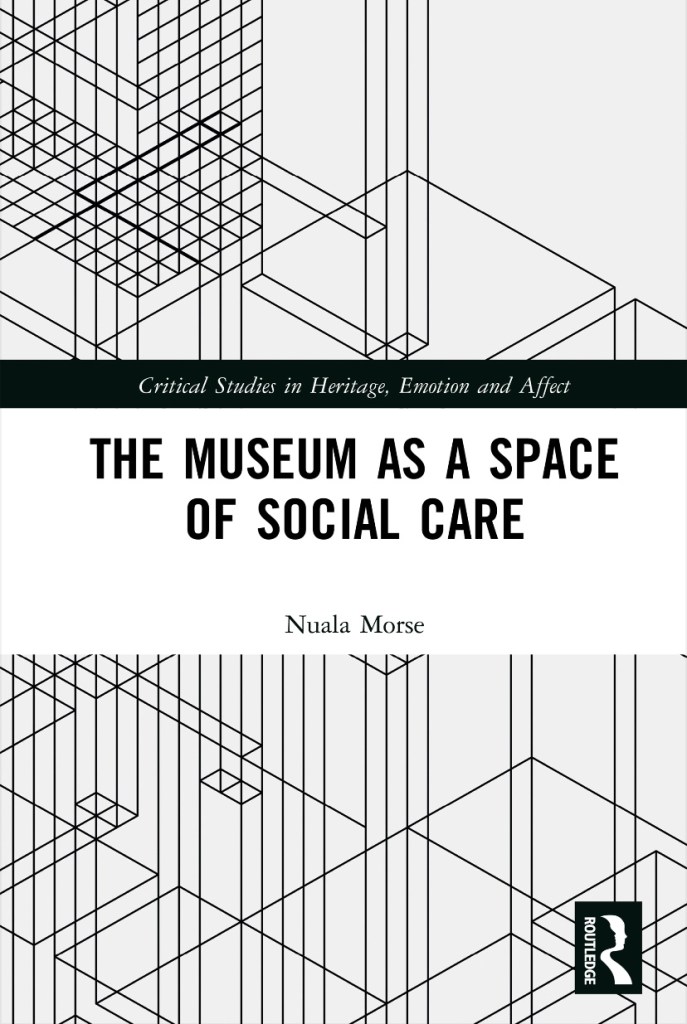
Nuala Morse was my personal tutor at university when I was studying Museum Studies at the University of Leicester. I loved her approach to museums and care, but at that point, I was more interested in curation, digital practices, and ethnography than care. Now that I am working in a community engagement role, where my main job is to work with people living with dementia and their carers, I wish I was more into care at uni. For my AMA, I am focusing on community engagement and inclusive practices at museums, and Nuala’s new book ‘The Museum as a space for social care’ is a perfect read for both those areas. I added it when I was making my CPD plan in late 2021 and I am so glad, it feeds greatly into what I do for work presently.
‘The Museum as a space for social care’ “focuses on the practice of community engagement in museums through the notion of care. It focuses on building an understanding of the ‘logic of care’ that underpins this practice, with a view to outlining new roles for museums within community health and social care.
This book engages with the recent growing focus on community participation in museum activities, notably in the area of health and wellbeing. It presents the practices of care that shape community-led exhibitions, and community engagement projects involving health and social care partners and their clients. Drawing on the ethics of care and geographies of care literatures, this text provides readers with novel perspectives for transforming the museum into a space of social care.”
‘The Museum as a space for social care’ was released in 2020, during the first of the UK lockdowns and it was more needed than ever to discuss ‘care’ in and by museums at the time of its release. Museum studies scholars and museum professionals have been working to progress traditional museums to shift focus from objects and colonial mindsets towards people, stories, participatory practices and inclusion. The idea of the social responsibility of the museums has been introduced, questioned and re-questioned. This book offers support on how to reach this ‘new normal’ in museums, especially after collectively experiencing a pandemic that furtherer the need to focus on people, needs and wellbeing. It gives us (museum professionals) a new perspective and set of terms on what it means to care within the sector, something we should all work towards to.
Morse conducted a long-term ethnographic research as her case study for the book that took place in the 2010s in Tyne and Wear Museums chosen for their “long-standing commitment to this work, led by the Outreach team.” She focuses on a larger shift in the sector with the example of Tyne and Wear Museums, that is the change of language from social inclusion to wellbeing and outreach.
‘The Museum as a space for social care’ offers a critical argument on existing theories and terms within community engagement used that lack a clear definition which leads to different understandings and practices within museums. Morse offers a broad but simple description of what care is (that is the main part of community engagement in her argument) that is supporting one another both emotionally and in practical ways.
This book offers an extensive literature review of existing theories regarding museums, community engagement and care (which I found really useful to be introduced to), while also an argument on how they differ and what they mean within different settings. Rather than a good/bad argument and without judgement, she introduces ideas about the logic of participation: ‘Logic of Contribution’ a dynamic based on centre/periphery that is more often than not about how communities can benefit the museum. Her counter-proposal is shifted vocabulary and a new perspective on how to think of community engagement, the ‘Logic of Care’, which is contextual, specific, and relational. Morse argues that both are fine and have space within the museum sector, however, with the ‘logic of care’ museums can offer more meaningful support, advocate for inclusion, and create places of social care both inside and outside museums.
I really appreciated the way the book was organised – easy to follow and get into more details as we went on. There were 4 main parts – first the academic context (literature review, existing theories), then the experiences of community engagement workers (a lot I can relate to and have experience with) and finishing the book on the main argument of community engagement is about care and the future. I love Morse’s envisioned ‘care-ful’ community engagement that is hopefully already more and more existing in the sector. The theory of ‘logic of care’ and ‘care-ful’ engagement are helpful guides of theory and practical ways to develop community engagement practices in museums. It aims to spark ideas and start conversations rather than dictating the right or wrong way to do community engagement.
‘The Museum as a space for social care’ ends with a future focus on museums, aiming to raise awareness of community engagement and its workers and care in museums. Morse sounds optimistic about the future of museums as she already observed changes in museums regarding care, wellbeing and outreach and hoping for a better ‘care-ful’ museum sector.
I learned a lot through this book from the changes and history of community engagement in the sector to care in museums. There was a lot of relevance to what I do and reassured issues I have experienced lately working as a community outreach person.
The only thing I missed in the chapter on the Emotional life of community workers is more of the actual emotional impact of caring work in museums. The chapter was focusing on the emotional work of community outreach workers, and it focused on it theoretically more, up until the last half a page of the chapter which was what I hoping to know more about – actual experiences and some practical ways to support people doing caring community work. I don’t think it’s the fault of the book – rather I have been struggling lately emotionally and wanted reassurance and any help on how to protect myself better in the future. I love my job, and I love working with the people and participants in our Creative Reminiscing Sessions, but over my first year, I burned out once already and had to take time off to recover mentally. I believe that is from the lack of institutional support for our wellbeing as community outreach workers – not really understanding the emotional labour and stress this kind of work causes.
This book made me feel seen and heard, it offered new learning and curiosity about what others are doing and what theories are out there now. It was one of the best academic books I have read: offering theory and practical knowledge, proposing a new idea as a way forward without labelling other theories as ‘bad’. I also appreciated the language Morse used, a mix of academic and informal, that offered a more personal, inclusive, representative and understandable piece of writing. I would highly recommend this and not just to museum professionals (although a must for community outreach workers and managers of organisations) but to anyone – bringing ‘care’ to our way of working and living would offer a healthier and more inclusive society.
 Hugs and Buttons