“The Engaging Museum offers a set of principles that can be adapted to any museum in any location and will be a valuable resource for institutions of every shape and size, as well as a vital addition to the reading lists of museum studies students.”
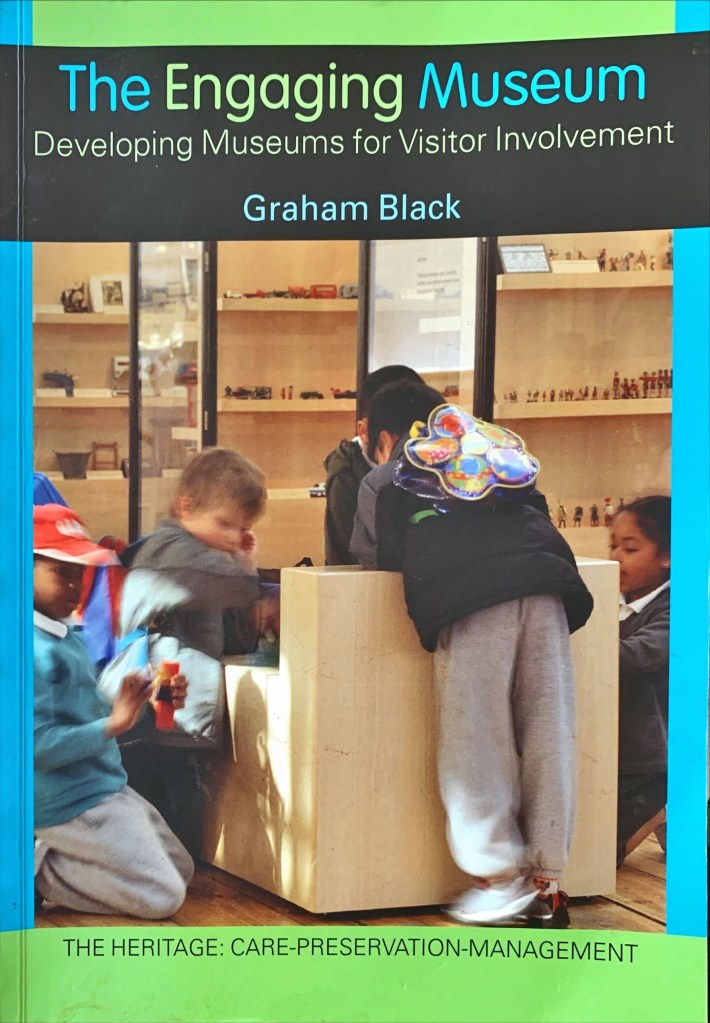
I read articles from Graham Black before, and I enjoyed his writing style and his focus on engagement. His writing is easy to understand and relate to as it is always a mix of practical advice and theory. I feel that it is a special thing in museum studies books – as they are mostly about ideas and nothing about the ‘how to’, which often left me quite hopeless. I instantly liked this book based on the title (tells you exactly what it is about). The words used in the title such as ‘engaging’, ‘developing’ and ‘visitor involvement’ offer a new way of thinking in a museum setting where things are changing for the better. Rather than fixed and old-fashioned these words suggest an ever-changing, flexible and people-focused mindset. On the cover of the book, there is a picture of children playing and engaging with each other and the collection. You can see from the picture that they are moving around which offers the idea that they are allowed to move, play, and enjoy themselves in a museum setting, which Black is encouraging throughout his book.
The Engaging Museum is a practical guidebook which offers insight into visitor experience and how to achieve its best version in museums. As it was written in the early 2000s, it offers us a historical moment when museums are becoming more modern in the sense of prioritising people, stories and engagement over collection and strict school learning. Black examines each stage of the visit from welcoming at front of house, planning an exhibition to setting up the museum and its vision with visitors in mind.
Black focuses on the big picture, while also explaining all the small details and actions that are needed to create the best experience for people (as accessible and open as possible). “This holistic approach will be immensely helpful to museums in meeting the needs and expectations of visitors and building their audience.”
This book features theoretical ideas and practical solutions supported by case studies to see examples of ideas put into practice in real museums. There is a great selection of figures, tables, models and photos that support learning in different ways.
This book has a great format. Black divided the book up into 4 main sections: Museum Audiences: Their Nature, Needs and Expectations, Operating for Quality, Learning in Museums, and Planned to Engage: Using Interpretation to Develop Museum Displays and Associated Services. He then split these into smaller parts and then chapters diving into the topics and themes deeper. He talks about traditional and new audiences and their ‘how to’, visiting and visitor services supporting the experience, school, and lifelong learning and their ‘how to’, and ends with interpretation, concept development and the idea of the ‘engaging museum’. Each chapter and section have multiple formats of information ranging from case studies, discussions, further information in a box, and ideas illustrated in tables as well as pictures. This supported my reading journey as I kept losing focus and struggled to intake information. Black created a range of ways he offered information, therefore keeping my focus and interest up. He also summarises key points in each section which reinforces the information read already.
While I read this book almost 20 years after it was written, for me too it is the minimum requirement of a museum to offer engagement every step of the way from entering and designing exhibitions to what visitors take away from it. Nowadays, museums compete with all the other kinds of learning and immersive experiences as well as online and in-person popular culture entertainment. In the early 2000s, this is a new concept, but after 20 years this is something that we can see in all successful/popular museums. Museums that still prioritise collections to people and lack in offering a diverse learning experience to visitors are slowly dying out as they can’t grab attention from people, therefore will lose visitors.
Based on the cover and my previous engagement with Black’s writing, I decided to add this book to my AMA’s CPD plan. My main areas to focus on within my CPD are to improve my digital expertise and understanding of the use of games in museums, learn more about community engagement, the understanding and successful use of inclusive practice, and get experience in learning and education in museums. This book is supporting my understanding of community engagement, learning in museums and inclusive practice skills in museums. It also connects with my digital and interactive interest in the sector. This was a 10/10 book for my CPD learning goals.
At the time of reading this book, I am working as an outreach person in a museum in London, where I work with older adults and people living with dementia. This book emphasises the need to work with lifelong learners rather than only focusing on students and schools. This is still something that in my opinion could be improved – but there has been a lot of work in the last years to open out museums and offer more for adults and lifelong learners too.
The reason I loved this book was due to its easiness to read/understand and to relate. It focuses on things I know and want to know more about. It supports my thinking within the sector and different museums – he sets a great base of need for museums to engage with their visitors. I appreciated Black’s focus on offering different learning styles and ways and his following that into his own book. It did offer various learning styles and broke the sections up into easy-to-follow themes. Therefore he made it easier for us all to follow his argument and learn in our own styles from it.
The only thing that I struggled with is the age of the book. I found it was too old for some things mentioned. Some of the example case studies doing improvements at the time of the book have done another revamp or two since then again. Would love a newer version of this book I think we could further focus on people and inclusivity and experience, and he would be great at reflecting on what’s been done and what is needed to progress in this area. It is interesting to see how far we come in some things/how little in others in the sector.
 Hugs and Buttons