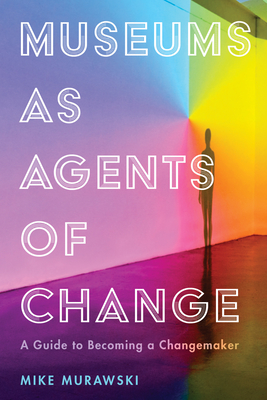
Museums as Agents of Change popped up on my Twitter feed for weeks last year, recommended by museum professionals I am inspired by. I kept noticing the cover as it is rainbow colour, bright and tells you exactly what it is by having the title spread across the whole cover. I have not heard of Mike Murawski before, but I liked the topic, the cover, and the people recommending it. It also has a recommendation by Richard Sandell, one of my Museum Studies teachers whose area of interest is exactly this – museums, change, and social justice.
“As the contributors to this powerful and important book make clear, anyone working in and with museums has a part to play in their transformation towards becoming places for social change, justice and equity. This beautifully written book, brimming with rich experience and insights, honest reflections, thoughtful provocations, and practical strategies for enacting change, is critical reading for anyone committed to translating ideas and talk into action.” (Richard Sandell – co-director, Research Centre for Museums and Galleries, University of Leicester)
It took me a while to actually order the book, but I got from my last place of work a book voucher as a leaving present and I felt that this is what I want and need so finally ordered it. This was last winter; it took me a bit longer to get around to reading it. I included this book into my AMA CPD plan as one of my goals is to learn more and do more about inclusivity, social change, and representation with the deadline of April 2022. This book covered all that both in terms of theory, but also practice and in dialogues with other museum professionals.
This book is all about the ‘how’ – how to create meaningful changes in museums, how to connect with people you work with and with your community, how to learn from the ideas and actions of others and how to learn by asking questions and starting conversations. It’s focusing on the work we (museum professionals, as well as humans) need to do to create a healthy workplaces and relationships and specifically on how to become changemakers. I love that it emphasises that you don’t do this kind of work alone, you are inspired and supported by others as well as you inspire others. It’s about all of us making changes and creating welcoming and empathetic spaces that allow these changes to create something new and meaningful.
Museums as Agents of Change reflects on theory and practices that relate to my Museum Association AMA goals – to be more community focused with more meaningful engagement as well as how to be more inclusive as an individual and well as a museum professional. It links in with my beliefs and values that I might have struggled to express, but through the book, I found exactly what I was meaning. I loved reading the interviews within the book – first, because the people who were interviewed are some of my favourite and most inspiring museum professionals I follow. It gave them a personal and professional voice outside of their articles and books, which I felt brought them closer to me. I was also loving the interviews because Murawski is a great interviewer, the questions were thoughtful, and he actively listened to answers rather than fitting them in with whatever he wanted. He also mentioned the museum movement ‘Museums are not neutral’ which I heard and learned about but didn’t know the context of. I have also been focusing on leadership skills in my work as well as in my professional development (AMA) and I loved Murawski’s mention of essential skills (that were slightly different than the traditional skills you read about for leading): Care, compassion, healing, deep listening, emotional maturity, sense of interconnectedness. These are normally mentioned as great personal skills to complement your professional skills. He pointed these out as essential. Most skills you read about for leadership are management skills, being inspiring, having a lot of experience, responsibility and decision making. These are of course important to lead but focusing on a human-centred approach, compassion, care and interconnectedness are just as important to create a sustainable and healthy environment. There is also a mention of how these skills are based on self-enquiry that you need to keep checking in with to be able to offer meaningful leadership. Not something you either have or not but something that will evolve with time if you work on it continuously.
“Well-researched and with lots of suggestions on how to be a changemaker, Museums as Agents of Change delves into the detail of process and practice for museum professionals looking to create a different future. Murawski’s book is a loving letter to those who are already making change, and salutes all those striving to be a better ‘us’” (Anna Cutler – director of learning and research at Tate)
This book was informative and inspirational, I felt that I can’t wait to start implementing some of the advice or great practices into my own. I agree with all things that were discussed, I do think the ‘community’ needs to be defined by individual institutions rather than just used as a broad term, I do agree about the importance of wellbeing and care for yourself and others, and I completely agree on museums being active spaces for connections and promoting empathy within our society. I fully believe that museums (everything else as well) should be human-focused (rather than money-focused) as people are the ones who work hard and do their best to promote positive values, cultivate relationships and create change – NOT institutions. I had a conversation not that long ago with a museum professional who mentioned sustainability within the museum is about care, wellbeing, staff support as well as business sustainability. I really appreciated this idea – I have known it and experienced it, but I have not been able to voice it before. Any organisation that has a high turnover reflects a lack of sustainability and stability. Promoting wellbeing in an institution as something we offer to the community (to who exactly) but doesn’t offer it to their own staff and volunteers (which is their biggest and closest community) doesn’t do it well enough. I see Murawski’s point about the need for changemakers especially post COVID as valid – we are not going back to normal as it was not sustainable, inclusive or healthy – we need to create something better, especially after experiencing the pandemic: the loneliness, closures, money-focused systems, colonial mentality, lack of support and lack of engagement.
I was inspired by the message of the book – you can work with the community, you can define community, and you can create change in your museum, however, it doesn’t feel easy and is not necessarily aimed at emerging professionals. We can barely get a job in the sector and if we do, we get entry level positions where we are happy to gain some experience for our CVs. I am quite low on the chain in the museum, even though it is a progressive, women-run museum and I feel heard, it is not easy to start a change or propose a change for the institution. I am passionate about social change, representation and inclusivity and I am lucky that in my job I am community outreach faced, but I am also impatient about when I could start creating real meaningful change. I feel you have to be either very charismatic or loud to achieve any meaningful change if you are at an entry level position.
I feel that this book was a great inspiration for my future career and what kind of person I want to be. It was reflective and informational, plenty of practices and ideas that can be implemented in our practices. I loved the dialogues being included in the book not just as a way to work together but to learn from others and show how to listen. I feel I will return to my notes many many times in the future as they are useful reminders of what we work for and where we want to be within society and in museums.
 Hugs and Buttons