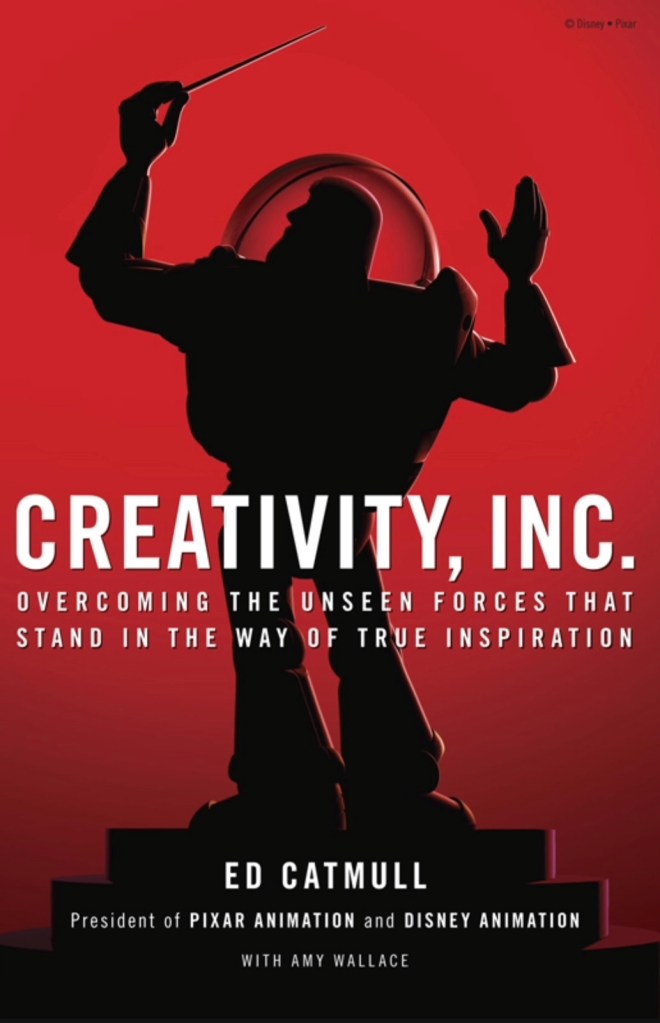
I found the book Creativity, Inc. through One-by-One’s book club reads. I keep following and adding their books to my reading list, but I am yet to read something on time so I could join their meetings. Hopefully this month.
I started following One-by-One after participating in one of their digital research workshops recommended by Ross Parry (Digital Specialism Course Leader at Museum Studies, Leicester University). It’s a national digital literacy building project for UK museums that focuses on the range of digital skills needed within the museum sector. Their book club follows their research and covers the skills, including leadership skills, individual and collective learning, digital confidence and of course museums. I keep a close eye on this reading list as I am doing my AMA and one of my goals is to develop my digital abilities along with management and learning skills.
Creativity, Inc.: Overcoming the Unseen Forces That Stand in the Way of True Inspiration was written by Amy Wallace and Edwin Catmull. I chose Creativity, Inc. due to its author, Ed Catmull, who is the co-founder of Pixar Animation Studies and president of both Pixar and Disney Animation. As a grown-up who loves animated movies (love both Pixar and Disney), I was curious about his journey running these two companies and was hoping that he would share some behind the scenes moments of my favourite movies. I got everything I was hoping for and more, as throughout the book, he focused on creativity and leadership as well as the evolution of computers and animation technologies during his career. He also shared many mistakes and failures that helped him become the leader he is today and assisted him in creating a work environment that supports ideas and people.
“Creativity, Inc. is a book for managers who want to lead their employees to new heights, a manual for anyone who strives for originality, and the first-ever, all-access trip into the nerve center of Pixar Animation—into the meetings, postmortems, and “Braintrust” sessions where some of the most successful films in history are made. It is, at heart, a book about how to build a creative culture—but it is also, as Pixar co-founder and president Ed Catmull writes, “an expression of the ideas that I believe make the best in us possible.”
Reading Creativity, Inc. felt like I was talking to a mentor (doesn’t matter what sector or profession). I learned so much about how to promote a healthy way of working, create relationships at work and lead people successfully. The book’s style of writing is incredible – the book has a personal feel to it – almost like a diary or email with friends. It contains reflections of his own life and achievements (described in a friendly and conversational tone) but the published work is also a professional guide-book as he shares details and specific stories about working in the creative industry. It is also very visual: the way events, conversations and people are described make it easy to imagine them and to feel like you, the reader, are part of the story. He uses conversations, meetings, and events to illustrate the facts and events but also uses quotes from individuals, which, is make the facts feel like stories.
The book is written so honestly about both successes and failures: this was shocking at times due to not a lot of people sharing failures this openly and with real life examples. He uses examples of his own mistakes and thought processes and events and mistakes done by others (without blaming): showcasing the process of growth through difficulties as well as provide detailed examples of solutions to the particular problems. I felt that he is a humble person: even though he is the president, he was self-aware about his shortcomings and the fact that a huge part of his successes is due to his relationships and collaborations with his employees. The book is themed around mistakes and lessons learned – Getting Started, Protecting the New, Building and Sustaining, and Testing What We Know. Each section gives some background information, provides clear and relatable examples (everyday work meetings, bigger events, people’s opinions and thoughts, mistakes) and also includes personal stories which fit the sections’ theme (focusing on specific lessons and mistakes). He finishes the book on a chapter dedicated to Steve Jobs – a partner, a mentor, a friend, and a genius. Catmull recalls his memories of their working partnership and friendship, while also praising Jobs’ genius and his personal transformation which made him a better leader, partner, and person. The book ends with a list of the key advice from the chapters which is organised into a clear list, making it easy, clear, and focused (see some of the advice at the end).
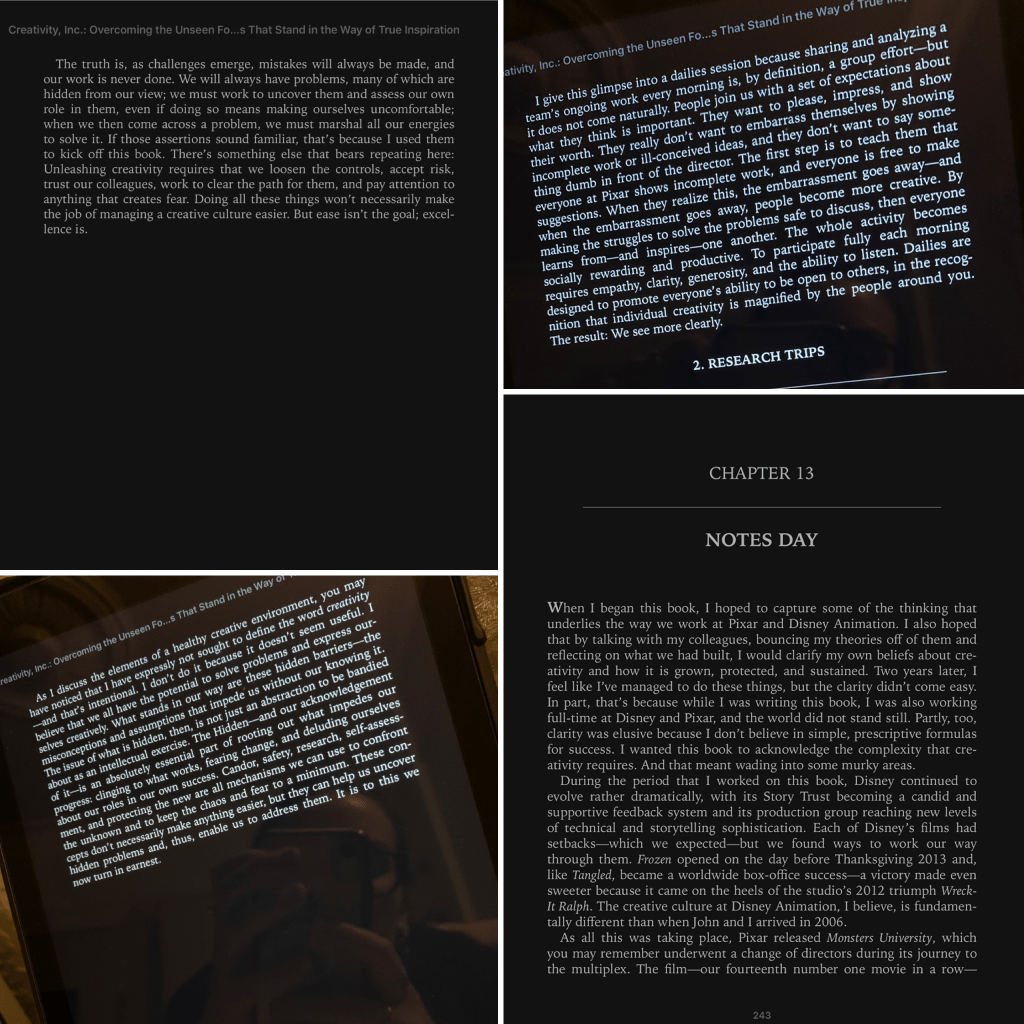
One of my favourite things about this book is how he admits being unsure and in the wrong and the way he acts about these things, learning and working on solutions rather than blaming others and being arrogant about his own position. It is especially relatable for me as a first-time manager at a job with no training on how to lead and manage others.
The other favourite part for me was the movie examples and stories. Loved reading about original ideas (and how much they change before the final product – the movies we know – is released), backstories as well as mistakes and successes of different directors, producers, and animators within the company. Catmull also shares pop culture references, Star Wars refences (loved them) and little inside jokes and comments.
In the book, Catmull also shows us his dreams and goals through his career – achieving them, feeling burned out when completing them (I feel these are issues we should be talking about a lot more in all sectors). He also shared his core values (both personal and business) and the ways he implements them in his style of leadership. In the book some of these values are revaluated as circumstances and people change but some are also kept even when challenged by various events.
Catmull focuses a lot on fear within a working environment – fear of losing, failing, letting go of control, uncertainty, changes. Nevertheless, while acknowledging the various fears, the author argues that trust is more powerful in the long term and crucial for a healthy work culture. This trust should be present in all areas – trusting the process, trusting each other, trusting new ideas. He argues that “the unpredictable is the ground in which creativity occurs” and follows this idea in his way of managing. He promotes a socially rewarding work environment where individual needs and talents are appreciated and acknowledged, while also bringing people together to share diverse ideas and create a sense of belonging and connection.
Here are some of the lessons from the book that I believe are important in any work environment:
- “Give a good idea to a mediocre team, and they will screw it up. But give a mediocre idea to a great team, and they will either fix it or come up with something better.
- If you don’t strive to uncover what is unseen and understand its nature, you will be ill prepared to lead.
- It’s not the manager’s job to prevent risks. It’s the manager’s job to make it safe for others to take them.
- The cost of preventing errors is often far greater than the cost of fixing them.
- A company’s communication structure should not mirror its organizational structure. Everybody
should be able to talk to anybody. - Do not assume that general agreement will lead to change—it takes substantial energy to move a group, even when all are on board.”
References:
- Catmull, E. and Wallace, A. 2014. Creativity, Inc.: Overcoming the Unseen Forces that Stand in the Way of True Inspiration, Random House, New York
- http://www.creativityincbook.com/about
 Hugs and Buttons