Let’s see if we learned anything from this pandemic. And no, I’m not talking about masks and hygiene musts or even kindness and acceptance…. I am talking about realising the importance of digital capabilities and literacies.

Since last March (Lockdown number 1) a large majority of people had to change their ways of working. They had to adapt to work in more digitally confident and driven way. Some people adapted without issue, however, others had problems and lacked digital capabilities. Their respective organisations had to recognize their lack of skills and to offer training, so that their employees would be able to work from home with the necessary digital equipment. I believe that this should have been done sooner and not related to a pandemic. Digital literacies are the base that is required to function fully in a modern society. Organisations are slowly noticing that it is important for them as well as their employees to be digitally confident and incorporate digitally aware thinking into their institutions. This incorporation may occur by, firstly, providing access to digital technologies as well as training (for example, via workshops) to use them comfortably. Institutions should also commit to researching the matter, as both a potential positive and/or negative addition.

I am coming from the museum sector (at least trained in that field) and what I learned and seen is that it is important that sectors work together and collaborate in order to be able to develop skills and create and/or increase access to digital technologies. It is also important to note that the main and most important focus of these developments should be the people and their needs. In addition, organisations and even whole sectors often see the incorporation of the digital into their practice as a financial burden (buying new technology, upgrading etc.) and a communication challenge, while ignoring the fact that digital thinking is both

1) a behaviour, culture and skills, which respond to people’s needs in modern societies and

2) a practice/process, which is people-focused and also benefits their sector.

I also focused on the importance of digital literacy in primary education recently and what I have read suggests that it is where we should start. As we are becoming more and more reliant on digital technologies, children often learn by themselves the necessary skills to navigate digital technologies. However, I think incorporating digital literacy into their formal learning helps to create equality in digital skills; provides the pupils with with a safe and conscious mindset which would accompany their digital learning journey; and helps to develop empathy, inclusivity, and responsibility. Digital skills education should also work together with families and communities as well as be constructed in a way as to cater to different abilities and needs, since, as I have mentioned before, these skills are crucial to life within the modern society.

I would argue that transforming the curriculums with digitally aware thinking would raise awareness, start conversations and support children in their capabilities from an early age. It would also create digital equality – in skills and understanding – that would benefit all sectors and all people.

Digital confidence skills must arise from an inclusive and collaborative learning environment. Thus, sectors should be working together in an open and safe space in order to understand what needs to change and what has already been changed and led to successful and confident digital work. By teaching digital skills to children, they would be able to adapt to this digitally aware way of thinking, which would benefit them in all parts of their lives and equip them with the tools to deal with the changes and the challenges uncertain future might bring. 
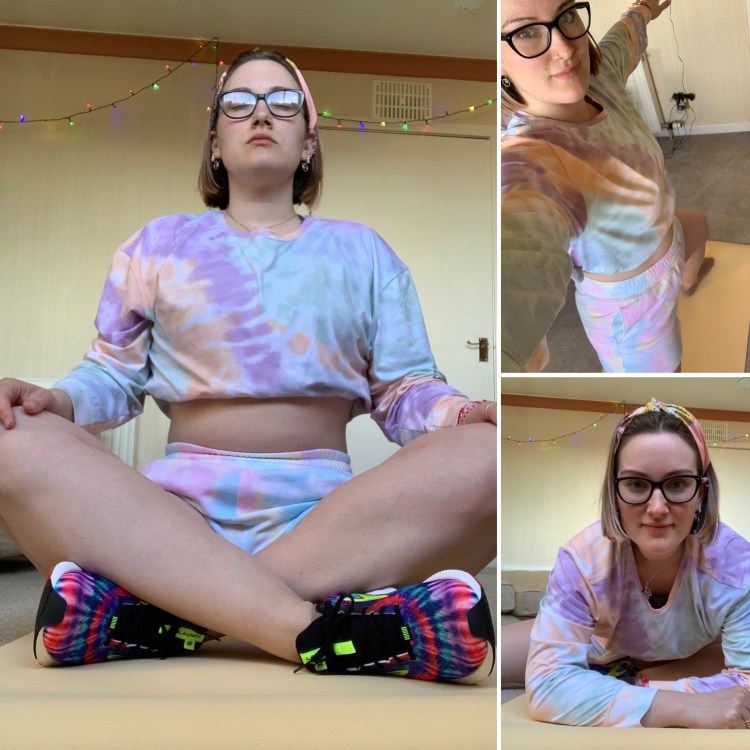
My Yoga-versary 🧘‍♀️

While the country decided to commemorate (remembering the suffering, connect with people over shared pain and experiences) the start of national lockdown, which is important as we recognise the hardship and pain people faced this year, I choose to celebrate it as my 1 year-yoga-anniversary 🎉 It very much starting out of frustration, pain and feeling of stuck-ness (in Leicester of all places). Since the 23rd of March 2020, I have done daily home yoga practices with Yoga with Adrienne, and of course Benji was an important cute part. Adrienne is also an incredibly kind and thoughtful person and as a yoga teacher she is very deliberately choosing to be inclusive, welcoming and informal. She is giving us an option to believe in her ways of thinking but also humble and understanding enough to offer a space where you don’t have to believe it all.

I have done monthly challenges, mood motivated practices and playlists focusing on certain themes set out for specific months. I wanted to share what I learned and experienced throughout this year through my yoga journey to really just sum up what changed for me this year and also to maybe inspire others with this. Yoga – any form, length and seriousness is so so good for our mental health and dealing with our stress, I would recommend it to ALL. 

Of course the first thing I realised was the positive effect of yoga on my body, I have become more flexible and toned. I was able to hold poses longer and with more attention paid. Through yoga practices and pep talks from Adrienne I realised how to develop a trusting and more accepting way to live in my body, which made me confident that my body can hold me and do all the movements I want to be doing in yoga but also at new exercises.

What took a bit more time for me was to realise the positive effects on my mental health of doing yoga every day. At the beginning it offered me a routine for my days in lockdown, otherwise all I did was working on my dissertation. I missed going out, having classes and being around people and yoga helped me structure a day, where I take time off from studying (and of course procrastinating) to ground my thoughts and move my body. Yoga with Adrienne has given me a safe space where I can slow down, recharge and be calm and balanced. However, last autumn, when I started to work in a cafe – new environment, new people and strict rules regarding COVID – I really struggled with the stress of the changes of everything going from not working for months, being surrounded by my amazing family and focusing on writing a dissertation to dealing with people, rules and a whole different way of thinking and functioning. Over the period of two months my mental health was in ruins, however, by still doing yoga and seeing Adrienne everyday felt like I had a friend and a safe environment within the chaos and mess I felt outside. 

After Christmas, when things started to turn around I began to see how much my resilience has improved as yoga is what I learned to turn to when I feel out of control due to stress, anxiety or even fear sometimes. I recognised when I felt out of order and chose to do a class or two and by the time I was done I was ready to move on and function again. And now I am getting to a point when I learned to not to take myself too seriously all the time, not to overthink and analyse at least while exercising but be present and loose. (Thank you ‘knocking on heaven’s door) I can be silly and funny and out of control while knowing that I DO have the control and the key to ground myself. I need to give a special shout out to the Rainbow practice and Yoga Camp, both of which I repeated multiple times. The mantra of Yoga Camp for each day resonated so much with me and helped with my mental health while struggling at the cafe and with the pandemic.

I noticed  that I do struggle more and more to stay still, slow and focus on one thing. (It was there before COVID, but got more intense since all the lockdowns). Doing yoga every day developed my lacking focus. As most classes are around 20-30 minutes – roughly how long I can do something without fidgeting and thinking of other things. However, eventually I have started to slow things down, to crave this yoga as an important part of my day, a time that is dedicated for my mental state and my nervous energy. I have also managed to be present more and block out noises and happenings around me – which was necessary while living with my lovely family (with 2 young children) at the beginning of lockdown. Now I am doing yoga every day (MOVE – March 2021 playlist at the moment) as well as the Fast Burner Challenge by Les Mills, which is a 30 minutes a day exercise, which means that I can focus and dedicate my energy and time (an hour every day) to feel better by moving my body.

Yoga has also been an incredible way to end the stress cycle – learned from The Secret to Unlocking the Stress Cycle written by Emily and Amelia Nagoski. They argue that while we can deal with the stressors, we still experience the stress every day that needs to be dealt with as it just builds up and the best way to do it is with movement of our bodies. They call it the Stress Response Cycle that we can complete with any physical activity.

Design a site like this with WordPress.com
Get started