I had an amazing conversation with Aarushi about her studies, her roles and career and future goals as well as the entertainment sector.
I went to see her in Roobaroo (find the review here). Find out more about her here.
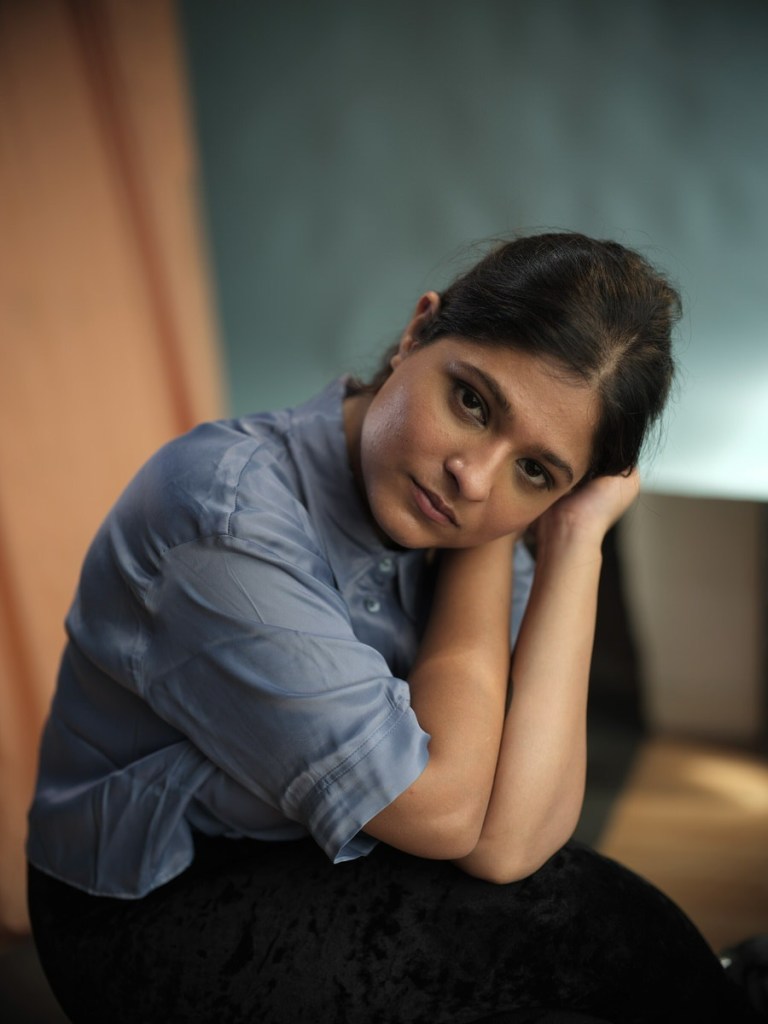
Sara – Hi Aarushi! Tell me about yourself. What are your interests and focuses, how you got to where you are now and what’s next?
Aarushi – I am an actor. I moved here from Mumbai, India to London 6 years ago to go to drama school. I did my training at Drama Centre, and I loved it. It was the most exciting and most intense as well as the most creatively stimulating time of my life. I was lucky to experience this in my late teens, early 20s because I think that is when your work ethic gets built up. It’s hard work at school but you are also on top of your work and dedicated, it’s great practice. Since graduating I have done a range of things: a few plays, radio, R&Ds, and appeared in some TV shows. I’ve done a wide variety of different acting, which helps me develop my skills and stay creative.
Are you deliberately choosing different media or is it what comes up and you are open to try?
I wish I could say that I am deliberately choosing it but no. Because I’m so early on in my career that I’ll try anything that comes my way. Most things I get through my agent. I’m just excited to get the scripts and to audition/tape for them. When I get parts it’s such a bonus. There have been only one or two things where I wasn’t sure about the role, everything else has been great. I worked with some amazing people in the industry, people I wanted to work with. I always felt excited for our collaboration. And also, because I’m a recent graduate it’s nice to get a taste of professionally working in different mediums as well. Most drama school training in the UK focuses on stage training. So to be on set and to learn that professionally it’s really exciting. Being in a theatre rehearsal room with other actors in a company it’s more familiar, but then in a professional setting that feels different too. I feel very doe-eyed at this point in my career.
Are the roles coming through your agents, so they pick out what would be more relevant to you, or do they come directly to you from the places?
Actually a few times I’ve received direct emails through social media or mutual contacts, owing to the network I have been able to create for myself in this country. Most other times, the roles come through my agent.
Do you have an agreement on what kind of roles you want, what kind of plays you would prefer? Is there a preference thing, or are they showing you anything that you might fit well into?
At this point, it is anything that sounds good that I fit well to – what I look and sound like, my background and my lived experience. If I had to say, it would be theatre and classical works. I love Shakespeare and anything Jacobean.
Is that what you would like to try more in the future?
It’s definitely one of them. I’ve done loads of plays and classics in drama school, and I do workshops as well alongside jobs where I have done Jacobean work and Shakespeare, but that is something I’d love to do professionally. But also, being on TV shows as it’s so new to me and I feel like there is more to discover, so I’d love to keep that going. I really enjoy radio work as well. I’ve learned an incredible amount from being on a voiceover job. I was really lucky to be a part of BBC radio’s Antony and Cleopatra last year. One of my favourite actors was playing Cleopatra. I felt like being in drama school again when I had my first day on scene with her. I got distracted by her as I was just staring at her. She had to tell me that it’s my turn next and had to tape again, because I was so mesmerised by her performance. I learned a lot from that job. I had another radio job a few months ago this year, which again is just such a very different medium to being on stage or screen. Everything teaches you something new, so it’s all very exciting.
It sounds varied enough so you can try your hands at a lot of things. What’s your dream role, location or play?
I would love to be in any of the London or regional theatres, I just love them. As a dream role, I recently watched Romeo and Juliet at the Almeida theatre and it’s been on my mind since. I would love to do that, but maybe with a different focus and with Indian influences. There are a lot of communal disagreements and disturbances in India as well as visual and musical influences that would translate really well to the play. I would love to do something like that – just waiting for a theatre to devise a production like that and give me a call!
Is that something you would make happen in the future if it hasn’t already? Would you write it or is it a whole different set of skills?
It is a different set of skills, writing and producing all of that is an immensely difficult and disciplined part of the industry. But it’s something that I have thought about. As an actor, you’re always encouraged to make your own work. And it is a really good idea. I haven’t gotten through it yet, but I would. Also, I have some incredible friends in the industry, directors, writers, producers, who I’m sure would be happy to speak to me about it and try to help me navigate this world. It is in my mind especially with the writers’ and actors’ strike.
Tell me about the strikes. I didn’t know it was reaching across to the UK. Is it something that is happening here as well?
It is mostly happening in America, but because there’s so much work between Britain and America it’s affected here as well. A lot of the auditions that I get would be American shows or an American collaboration. A lot of the British writers and actors who work here are also members of SAG and the WGA. It has affected production on TV shows, movies with actors, working on stage, it’s made that difficult. Theatres are still going ahead, but not TV and film and there’s a lot more volume of work happening on TV and film now, so that’s affecting auditions.
I think even if it’s happening in America and it’s affecting them, it is something that inevitably will affect us here as well. Getting more protection in place for them is ultimately going to be good for us as well. We just have to breathe through this, then hopefully, soon there will be positive changes in the industry.
I always imagined that your sector is not necessarily the most supportive, not necessarily the nicest, but as I talked to people in the industry, I think that is changing and it is shifting my assumptions. You said you’ve got great friends and support within the field. Is that what your experience has been since you started?
It is to be honest. It depends, but for me, because of my training at a drama school and you know, I found my community there. The people I met at drama school are still some of my best friends. I’ve met more people on jobs and they have been amazing too, but they are still my core friends.
In terms of the industry and not having support, I would agree with that. It can be alienating because everyone’s on a very different journey. There are some people who will overnight book a massive job and from there it’s just job after job. Whereas for others, it takes a bit longer or it’s very slow, and then something big and then nothing. Everyone’s path is very different. And especially when you’re friends with creatives, you end up mostly talking about your career and that can sometimes drag you down. It is important to remember that other people’s successes doesn’t mean your failure. It can be really difficult though, it’s an industry that promotes and encourages competition that breeds insecurity and uncertainty.
Do you have a process on how you get ready for auditions? Do you have a routine from getting a script to audition? Is it something they train you for at the school?
Yeah, you spend three years developing your own method. They also have a method they teach you at Drama Centre. It’s got a very specific structure on how it teaches acting and how it encourages you to learn, but then it’s up to you to pick and choose what you like and then create your own process. With every audition, I think it is a little bit different. Just depending on how much time I’ve got, if I’m doing a job at the moment, but normally as soon as I get it, I’ll read the script. And then I have a way of doing analysis on it and figuring out what I think the character is. And the most important thing I always think is ‘what do they want’? Because that’s what keeps it active and alive.
I’ve been very inspired by a few actors recently who talked about method acting. So, I have been trying to be my character an hour before the audition – what would they do, how would they make their cup of tea etc. I don’t know yet how I feel about it, but it’s something that I’m curious to explore more. It can also be fun to just tap in and out of things – find the distinction between yourself and the character.
But the basic premise I always keep in mind is what they want and how they are going to get it. I feel like after training at school and trying out different methods, I have a good idea now of what works for me and what doesn’t. But also, I’m constantly doing workshops and meeting new directors, trying to work with them, and that teaches me a lot of new perspectives and ways of working. I’m just very open to learning. It’s really exciting to hear or see someone talk about their work, or do their work and then realising that actually, I’ve never considered using that way of working before and then trying it out for yourself. Something that affects me a lot is images, art and poetry. I love art in every form. I always try to find a poem with every character that I play, something that I feel relates to the character or helps me find a way into them.
I actually never thought about this. That when you have a character, you have to do your interpretation, analyse your script, and maybe having a poem that describes the feeling of the character helps you play it. It sounds like you must be quite open and adaptive to what feeling it gives you or imagining putting yourself in another person’s shoes. It sounds beautiful but also quite hard.
Yeah, you need strong empathy skills. Empathising with other people and then those people end up becoming the people that you play.
I did anthropology at uni. And that’s similar, but it’s very different as well, because there is an academic barrier. You imagine but you don’t put yourself there.
I think there’s a lot of overlap of acting with psychology, anthropology. A lot of these humanities are really an exploration of the human condition. We found a million ways to do that acting is one of them, but also psychology, anthropology, criminology, theology, – they’re all different ways of that thinking.
What skills have you developed during your career and your lived experience that you find most important?
Staying active both mentally, emotionally, and physically. For me that means doing workshops, staying engaged with creativity, whether that’s going to see a play or a film or watching something that feeds me. Staying engaged creatively and active is matters greatly to me. Being resilient and optimistic are also really important skills that I think can really shift your perspective on your career. Because there are ups and downs and there are ups and it’s very easy to spiral. So, every day I try to be proud of myself.
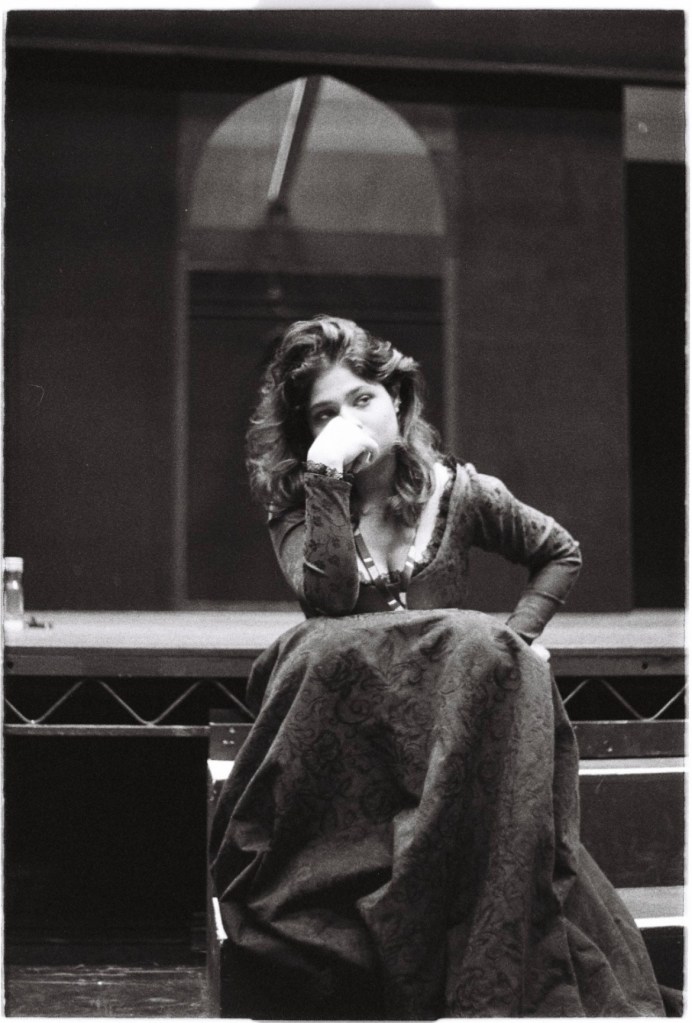
This is amazing, I love this! Thank you so much for sharing with me. I used to feel similar to you being at the beginning of my career in the museum sector. And I think I lost it a little bit. I think you have to be careful of this new love feeling because it could get overwhelming.
I agree. You have to be open, and you have to absorb everything, but with that you can also absorb a lot of negatives.
Tell me about the play you are in at the moment at The Space? It’s called Roobaroo. What is it about and what’s your role?
It’s a theatre company called Mrs C’s collective. They have an amazing programme writers’ focused programme. The Big Share is a new 12-month long writing festival that supports and commissions 4 emerging, early-career, and underrepresented writers on a new idea. There are four different plays happening by the 4 writers who are on that course and I’m going to be in one of them. I saw the casting call for it, I auditioned for it and I was really lucky to get it.
It’s a play called Roobaroo, written by Akshay Sharan and it’s directed by this fantastic director, Caroline Yu. It’s a play about family and about the things that brings you together as a family and the things that also pull you apart. It’s a really complicated dynamic between 7 different characters. They’re all going through a lot within themselves and with each other and how all of that plays out is the premise of it. And it just so happens to be about a British Indian family that is oscillating between India and Britain. To be in a rehearsal room with other South Asian creatives, has just been special and that doesn’t happen often.
It’s something I can relate to being born in India but living here now and being stuck in between these two worlds, and my characters can definitely feel that as well.
It’s a full production, we are doing the whole 90 pages. I’m proud of what we have discovered so far. I think the play has a lot of potential and I hope that it has a life outside of here as well. We’re all performing it, but it is meant to showcase the writer and the play. I feel a bit like that’s how every place should be. The writer should always be front and centre because without the writer you have nothing. Whether you’re working in film, TV or theatre, the writer is the most important person in the room.
 Hugs and Buttons